

A topic seems to emerge repeatedly in Board discussions and in conversations with members, though it often takes different forms depending on who is speaking. Someone says, I had no idea this was happening. Someone else says, There are too many emails. Someone says, I would have submitted something if I had known. Someone else says, There is so much information in one email that I do not always know what I should be paying attention to.
Communication is a strange thing.
In therapy, we sometimes tell one another not to worry about whether something seems to land immediately. We talk about planting seeds and trusting that ideas may continue growing long after the conversation itself ends. It is one of the things I love about working with humans: we are perpetually changing and making meaning in our own unique time.
Organizations, however, are a bit less patient. Seeds are wonderful, but conference proposals eventually close. Registration deadlines arrive. Events happen whether or not someone saw the announcement. Information needs to reach people while it is still useful rather than after the fact when someone thinks, Wait, I would have wanted to do that.
Occasionally I imagine the professional experience as all of us standing in separate rooms throwing pieces of paper under one another’s doors while periodically shouting, I didn’t know that was happening! and Please stop sending me paper!
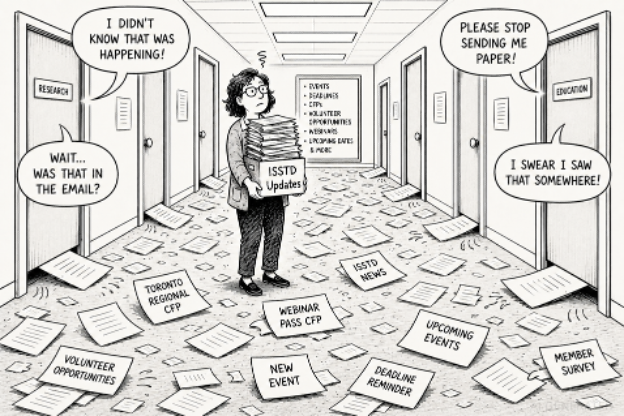
I suspect many of us have occupied both roles.
As an organization, we live some version of that tension regularly. Email remains our primary form of communication, and we are trying to help members stay connected to opportunities, events, educational offerings, volunteer roles, and developments within the Society while all of us simultaneously navigate inboxes that seem capable of reproducing independently overnight.
Recently we launched Calls for Proposals (CFP) for both the Toronto Regional Conference and, for the first time, Webinar Pass programming. Although both CFPs have now closed, I have continued thinking about what they were intended to create: additional pathways for participation and additional pathways through which ideas can move throughout the Society. Different opportunities fit different lives. Travel, schedules, finances, safety, geography, and competing responsibilities all shape what is possible for people at different moments. They also shape how ideas travel and whose ideas ultimately reach the rest of us.
We tend to hear most easily what is already close to us. We hear from people we know, around topics we already discuss, and in formats that feel familiar. There is profound value in that continuity and in continuing to deepen areas of knowledge that have shaped the field. There is also value in creating opportunities for something unexpected to enter the conversation. Strong educational communities depend upon both.
Proposal processes are also communication moving in the opposite direction. When organizations invite speakers or develop educational programming, we naturally begin with what and who we already know. That is not inherently problematic; many of us have learned tremendously from presenters who have shaped the field over time. But educational communities also need pathways for discovery. Somewhere within ISSTD there are people sitting with ideas they have been developing, clinical experiences they have been reflecting on, research they are excited about, or questions they cannot stop thinking about. I would be interested in hearing members’ thoughts on ways we can continue creating pathways for new voices and ideas to enter the conversation.
Communication is probably one of those problems that no organization ever completely solves. We keep sending information outward and hoping it reaches people at the moment it becomes relevant to them. We also continue creating spaces for ideas to travel back toward us.
The CFPs for Toronto and Webinar Pass may now be closed, but I am looking forward to seeing what emerges through both. Registration for the Toronto Regional Conference will be opening soon, while the 2026 Webinar Pass is already underway and continuing to expand the ways members can engage with educational programming throughout the year. And if you missed the proposal deadline this round, I suspect the CFP for Boston 2027 will likely arrive in your inbox sooner than any of us expect.
Warmly, and with one final reminder email,
Abigail Percifield, PsyD
President, ISSTD