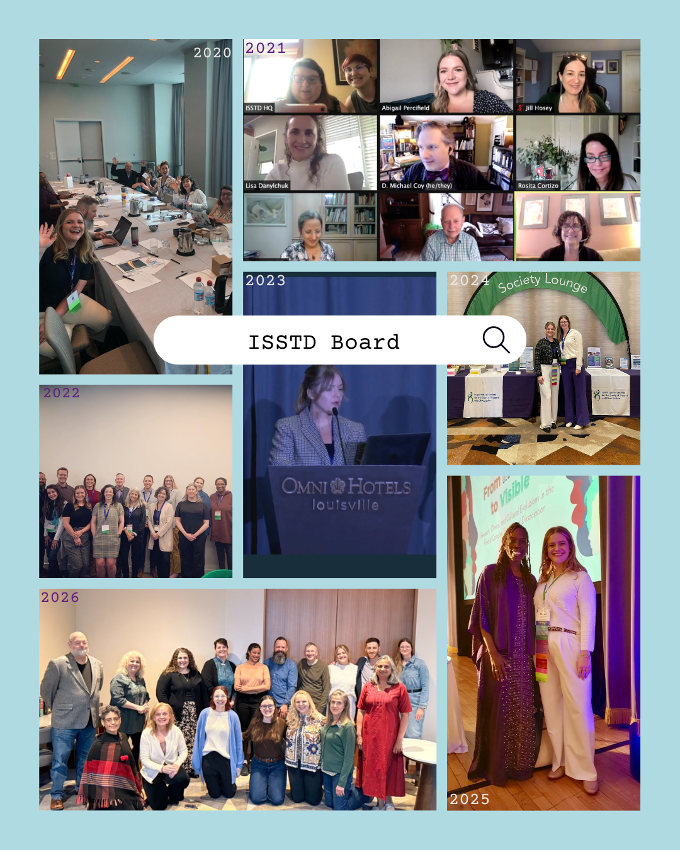
I have been trying to decide what to write about this month. At the end of July, ISSTD will be hosting our annual Board Interest Meeting, so writing about Board service felt like an obvious choice. As I sat down to write, though, I found myself listening to a familiar internal debate.
One voice said, Leadership. Governance. Networking. Organizational experience. Another voice replied, Yes, yes… we’ve all heard that before.
The first voice wasn’t wrong. Board service has given me all of those things. The second voice simply wasn’t interested in writing something that has already been written. So, I kept sitting with the question until a different answer emerged (and our editor kindly reached out to remind me that I had, in fact, not actually written anything yet).
In the traditional sense, we develop clinically by seeing clients, attending workshops, reading, seeking consultation, and slowly accumulating experience. Those are certainly the places where much of my learning has occurred. But when I sat with the question a little longer, I realized I could trace some of the biggest shifts in my clinical thinking from somewhere else entirely.
During my training, I was learning models of treatment that unfolded over years. Most psychotherapy models asked clinicians to think in terms of eight or twelve weeks. Treatment for complex trauma is different. I was reading case studies, listening to senior clinicians tell stories that stretched across decades of therapeutic work, and trying to imagine what that kind of treatment looked like in practice. At the same time, I was in my late twenties. My practicum placements lasted a year. I had never treated anyone for more than a year myself. I even moved apartments every year. Intellectually, I understood what long-term treatment meant. Experientially, I had almost no reference point for it.
Around the same time that I was beginning this work clinically, I also became increasingly involved in leadership within ISSTD. A strategic Board has its own relationship to time. Six years is long enough to watch presidents come and go, strategic plans begin and end, ideas emerge, disappear, and return years later under different circumstances. Board members leave, and new members arrive. Priorities shift as the organization changes while some questions seem to persist across every transition. The significance of a conversation is not always apparent in the meeting itself.
Board conversations rarely involve choosing between one obviously correct position and another obviously incorrect one. More often, thoughtful people are trying to protect different values, responsibilities, or long-term consequences that all deserve consideration. Progress depends less upon persuading someone to abandon their perspective than upon understanding what each perspective is trying to preserve and whether there is a way forward that allows more of the system to move together. It is impossible not to notice the similarities to treating dissociative disorders.
I have also thought of the value of experiential learning. When I attend a workshop, I often leave with pages of doodles and oodles of knowledge, excited to think about how new ideas might fit within my work. There is something wonderfully deliberate about that process that I will always love. Participating in a complex system teaches something different. Rather than learning a particular intervention, I gradually began relating to time differently. I became more patient with processes that did not yet make sense. More comfortable allowing competing needs to coexist without immediately trying to resolve them. More able to experience alongside my clients as meaning slowly emerged, rather than feeling responsible for moving it along according to my own sense of time.
Some forms of learning add knowledge. Others reorganize perception. When working in a profession that is both art and science, both are required.
Over six years, participating in a complex system changed how I understand time, conflict, relationships, and change itself. It just so happens those are the very things I spend my days trying to understand in the therapy room.
If you have ever been curious about board service, I hope you will consider joining us for our Board Interest Meeting on July 24 at 3:00 PM US Eastern Time. The Society benefits with each new cohort of members and all that they bring to the Board, while they, in turn, carry those experiences back into their professional lives.