

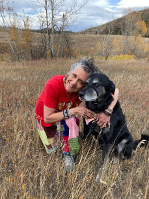
Flash Technique (Manfield, 2015) is one of my favorite techniques to use with children who have dissociation. Flash Technique allows us to process distressing memories and trauma painlessly. This technique can be used throughout the 4-Phase Treatment Model: Stabilization, Trauma-Processing, Integration, Post-Integration (Yarberry, 2019). The Flash Technique is easily combined with Prescriptive, Child-Centered, and Filial Play Therapy (Association for Play Therapy; Schaefer & Peabody, 2016). This article will feature examples of Prescriptive Play Therapy and Child-Centered Play Therapy. Animal Interactions, with Boaz, the therapy dog, added fun, support, comfort, and humor to the sessions.
The Flash Technique is an Eye Movement Desensitization Reprocessing (Shapiro, 1995) Protocol. Over the course of time, Dr. Manfield hypothesized three phenomena:
- “Unreportable” (subliminal) processing, bypassing conscious defenses
- Modified memory reconsolidation
- Cultivation of a present observer position, rather than reexperiencing” (2020).
The protocol is short and easy. The client chooses a target and rates the severity of their distress on the Subjective Unit of Distress Scale (SUDS), where zero means no distress and 10 is the highest possible distress. The client chooses a Positive Engaging Focus (PEF) (Manfield, 2020). which can be an event, activity, animal, music, play or anything that is completely positive for the client. Bilateral Stimulation (BLS) can be achieved with pulsers, tones through a headset, or tapping. During activation of the PEF, the therapist says, “Flash” and the client rapidly blinks three times without thinking of the target. A set consists of three rapid blinks, five times. Following 2-3 sets, the client is asked what is different. The process is repeated until the SUDS level is zero. Shebini, 2019, and Wong, 2019, detail clinical application of Flash technique for adults with dissociative disorders.
This 2-step process is essential before using Flash Technique with children for the best possible outcome:
- Identify the parts of self
- Ask permission from the parts of self – if all or some want to join the child; if some do not, I ask the child if those parts would like to support the others or go to the park, bike ride, playground, etc., during Flash Technique processing.
I have successfully used Flash Technique during the first or second session in the Stabilization Phase by following the 2-step process.
To promote the theme of integration early in the treatment process, I might also ask the child if there is a group name their parts would like. Team or a sports team name, Special Helpers, Special Friends, The Guys, and The Girls are some common terms. Sometimes, the parts prefer to be acknowledged individually for a period of time before they are ready to be recognized as a group.
Permission from the children and parents was granted in the following vignettes. Pseudonames are used for the children and descriptions for the parts of self without disclosing their names.
Stabilization Phase
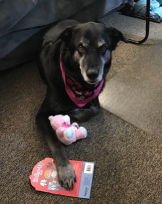
Ginny is a very bright 9-year-old, with an early medical trauma history. She bonded instantly with Boaz, the therapy dog. She began her sessions with tricks, treats, hugs, and loving expressions for him. Ginny’s mother is very supportive, attuned, and skilled at practicing the parts work and specialized parenting techniques between sessions.
In one session, Ginny’s mother reported that Ginny had a persistent habit of skin-picking, which often interfered with the healing of minor wounds. Ginny lifted her sleeve to reveal a small, bandaged wound and stated her readiness to resolve the issue. Her special helpers were ready, too! Ginny identified nervousness and excitement, which were felt as one emotion, as the trigger to skin-picking. She rated the SUDS for nervous/excited at 7-8. Using Prescriptive Play Therapy, I suggested that Ginny create a special place in the sand tray, where her special helpers could go whenever they needed or wanted to. Boaz led the way to the playroom with his favorite bone hanging out from one side of his mouth like a cigar.
Ginny’s mom sat in a chair a few feet from the sand tray. Boaz nuzzled her arm, then contentedly laid at her feet as he watched Ginny create a place in the sand tray for her special helpers. I followed her and used the magic butterfly wand to apply BLS to Ginny’s shoulders as she thoughtfully selected miniature toys from the surrounding shelves. We completed several rounds of the Flash Technique using her active creation of the special place as the PEF. We checked the SUDS rating and Ginny reported it was down to 1. She stated that her special helpers were OK with that and did not want to go lower. Ginny described how and when her special helpers would use their special place. She also decided on a group name to signify they were all working together. Ginny and her special helpers used the Butterfly Hug (Artigas, 2014) to tap into the positive feelings the special place provided. I took a Polaroid photo for Ginny and her mom to utilize between sessions. Ginny chose a code word for her mother to use, if she started picking her skin. The following week, Ginny and her mother reported that the cue word was only needed once, and the skin-picking had completely ceased.
Trauma-Processing Phase
5-year-old Derrick loves to build things with wood, paper, paper-mache containers, pipe cleaners, and any other materials he finds. He is quite clever and eager to use all kinds of tools. Before Derrick was adopted as an infant, he experienced neglect and abuse. He was often left with young adults that he did not know, and his basic needs were not provided. Derrick was eventually rescued by police when someone saw him being transported in a car without a proper car seat and called 911.
Derrick’s mother patiently practiced the specialized parenting techniques between sessions and developed a relationship with the parts of self, which Derrick called his special helpers. His progress toward his goals was variable. One day a very sullen-faced Derrick shuffled into the office, petted Boaz and fed him treats before bursting into tears. A family member had reacted strongly to an incident involving Derrick accessing tools he was not permitted to use without supervision. I used Child-Centered Play Therapy for Derrick to express his feelings and measure the level of distress. He disassembled several nesting dolls, scattered them across the table to show that he and his special helpers felt torn apart. The spaces between the dismantled dolls communicated a high level of distress. Derrick and his parts chose the pulsers for the BLS. His PEF was humming songs, telling jokes, listening to one of his favorite songs, and laughing at Boaz chomping on his bone. After several sets, I checked in with Derrick and asked him to show me how big the feeling of torn apart was. He quickly reassembled the nesting dolls, lined them up, smiled broadly and announced that everyone felt back together and loved.
Integration Phase
Angel is a talented 9-year-old girl who loves to dance and sing. She experienced early medical trauma that spanned her first 5 years of life. She fully integrated in less than 2 years; however, the divorce of her parents destabilized Angel, and some of the parts reemerged. She developed generalized fear which significantly impaired daily functioning. Her mother reported Angel was disproportionately scared of nearly everything. Boaz was a source of grounding in and between sessions for Angel. She strung his Polaroid photos across her room as a reminder of the superpowers he had given her. Angel always began her sessions with treats, belly rubs, and conversations with Boaz. He usually snuggled next to her on the sofa during check-in and shadowed her in the playroom.
Using Prescriptive Play Therapy, I asked Angel if she would like to create a place where her special friends had everything they needed, and we could use this as her PEF. Angel stated she wanted to draw everyone being happy. She rated the level of scared as “Super big!” She chose the pulsers for the BLS and placed them under her knees while she sat on the sofa and prepared to draw. We adjusted the strength and speed to her preference, and I asked her if she wanted to talk about everyone being happy. Angel said everyone was ready and began drawing and narrating as she created images of her special friends, the butterfly, fox, and duck being happy. After several sets, I checked the level of feeling scared. Angel reported that she and everyone were feeling a lot better. To get a more accurate measure, I asked her to show me with her hands how big it felt when she started. Angel stretched out her arms as wide as possible and then brought her hands together to show that the scared feeling was gone. Suddenly she threw her arms open and rocked side to side indicating that the duck was still super scared. She stated that the duck wanted to go into the art room and help Angel draw a picture of him, because he really liked the big paper and cool paint markers. We transitioned to the art room and continued the BLS with Angel’s narration of her and the duck’s drawing as the PEF. After several more sets, Angel reported that the butterfly felt great, the duck was not scared anymore, the fox was not scared anymore and glad that her friend, the duck, was not scared. Angel stated that she felt good because the duck was not scared anymore!
In her next session, Angel announced that she was one and could not see anyone on the inside. Angel has maintained full integration and continues to adjust to life with divorced parents. Her mother coaches her on using her emotional regulation techniques, which includes putting on Boaz’s strength as needed.
Post Integration Phase
8-year-old Jamey participates in numerous sports and is an avid dog lover. Jamey giggled when Boaz ran out to greet him in the waiting area and they were inseparable in sessions. He experienced trauma during infancy and intermittent distress until approximately age 7. This resulted in self-harming behaviors and rapid state changes that significantly impaired school and home life. His supportive and attuned mother participated in Jamey’s weekly sessions through the Integration Phase. She also applied specialized parenting techniques between sessions. Jamey rapidly progressed through Stabilization, Trauma-Processing, and Integration Phases. After “becoming one Jamey” he improved academically and socially at school. He also had very few, minor challenges at home. His sessions were reduced to bi-weekly followed by monthly sessions for maintenance. Because of the social/emotional developmental delays that remain after integration, peer relationships can be challenging at times.
Jamey sauntered into the office with his hand on Boaz’s back. He laid on the floor and buried his face in Boaz’s thick, furry neck. His mother reported Jamey had had an incident that involved relationship discord with school peers that morning. I explained to Jamey and his mother that sometimes kids at school remember the negative behaviors that made it hard to be friends with Jamey before he became one. I stated hopefulness that in time, kids would accept and get to know who he really is.

Using Prescriptive Play Therapy, I set the markers, crayons, colored pencils tray and blank paper on a clipboard next to Jamey. I sat on the floor near him and Boaz. I asked Jamey if he could draw his feelings about the incident. He reached for a colored pencil without making eye contact, sat half-way up, and drew a simple sad face. Jamey laid back down on the floor facing Boaz with one hand on Boaz’s shoulder. Boaz responded by placing his large paw on Jamey’s arm. I use a small paint sponge to apply BLS to Jamey’s shoulders while he talked about all the things he loves about Boaz. After a few sets, I asked Jamey to draw his feelings again. He drew a big, smiley face and told Boaz that he loved him. Jamey smiled, joined his mother on the sofa, ate a snack and drank cocoa with marshmallows. At the end of the session, Jamey kissed Boaz on the head and gave me a big hug before leaving the office.
I found Flash Technique can also be easily incorporated with Equine Interactions and Nature Therapy. Children can enjoy processing traumatic and distressing memories when they are focused on play and fun activities rather than the negative emotions, beliefs, and/or events. Dissociative symptoms/behaviors can cause disempowering and shameful feelings. The opportunity for children to be in charge of the BLM they prefer is empowering. They often giggle when experiencing the pulsers or tones or butterfly wand for the first time, which is a terrific segue into their choice of PEF! Smiles and light-heartedness evolve as distress quickly dissolves. I am grateful for Dr. Manfield’s expertise, creativity, and desire to develop an effective technique that does not require re-experiencing the initial source of distress or trauma.
References
Association for Play Therapy https://www.a4pt.org/default.aspx
Manfield, P., Engel, L. (2020) Memory Reconsolidation, the Flash Technique and EMDR, Webinar Training
Manfield, P., Lovett, J., Engel, L., & Manfield, D. (2016). What is the flash technique in EMDR therapy? Retrieved from: https://www.serenityoakswellness.com/blog/what-is-the-flash-technique-in-emdr-therapy, June 18, 2021
Parker, M. M., Hergenrather, K., Smelser, Q., & Kelly, C. T. (2021). Exploring child-centered play therapy and trauma: A systematic review of literature. International Journal of Play Therapy, 30(1), 2–13. https://doi.org/10.1037/pla0000136
Schaefer, C.E. & Peabody, M. A. (2016).Glossary of Play Therapy Terms https://cdn.ymaws.com/www.a4pt.org/resource/resmgr/docs/Glossary_of_Play_Therapy_Ter.pdf
Shebini, N, (2019). Flash technique for safe desensitization of memories and fusion of parts in DID: Modifications and resourcing strategies. Frontiers of the Psychotherapy of Trauma and Dissociation, 3, 151-164.
Wong, S.-L. (2019). Flash technique group protocol for highly dissociative clients in a homeless shelter: A clinical report. Journal of EMDR Practice and Research, 13(1), 20-31. https://doi.org/10.1891/1933-3196.13.1.20
Yarberry, M. (October 10, 2019). Proposal to the Field: Fourth Phase in Treatment of Dissociation Protocol. ISSTD News, Kid’s Korner. Retrieved from https://news.isst-d.org/proposal-to-the-field-fourth-phase-in-treatment-of-dissociation-protocol/